Romero scenic design cover image
Scenic Design

Romero

The world premiere of Romero was staged as a ritual container for memory, rupture, and spiritual reckoning rather than a literal historical reconstruction.

A Ritual Rather Than a Reconstruction

When I first read Xiomara Cornejo’s Romero, I knew the design had to hold more than history; it had to hold ghosts. Set in the final hours of Archbishop Óscar Romero’s life, the play bends time and invites the dead to speak. It is not realism. It is ritual.

Sacredness and Rupture

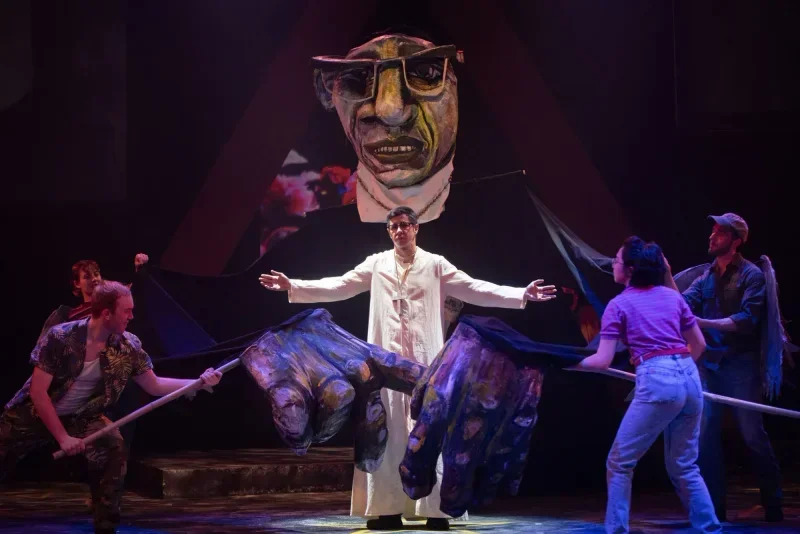
The scenic world emerged from the tension between sacredness and rupture. At the center stood a cruciform arch, part cathedral and part memory portal. Below it, a fractured platform and a textured black floor marked with five-point stars anchored the action in both earth and spirit.

The play’s nonlinear structure demanded a space that could shift between a beach, a church, a war zone, and the afterlife without literal transitions. Projection surfaces echoed the altar at Hospital de la Divina Providencia, while lighting and media traced the line between past and present.

Ritual, Rupture, and Witness

Lil Lamberta’s masks and oversized figures break the surface of realism, while Cherie Sampson’s projections keep each moment anchored in living memory. The design welcomes those interruptions instead of smoothing them over, so shifts in tone, time, and identity can land with real force.

Romero is larger than a single life. The space had to hold a nation in spiritual reckoning, which meant listening closely, leaving room for silence, and letting the room carry witness as much as image.

Production Credits

Romero

Written byXiomara Cornejo
Directed byDavid Crespy
Scenic DesignBrandon PT Davis
Costume DesignMark Vital
Lighting DesignVincete Williams
Sound DesignMichael Webb & Joseph Seevers
Projection DesignCherie Sampson
PuppetryLil Lamberta & Claire Bronchick

Project links

Related project context.

Production pages and writing connected to this scenic design.